

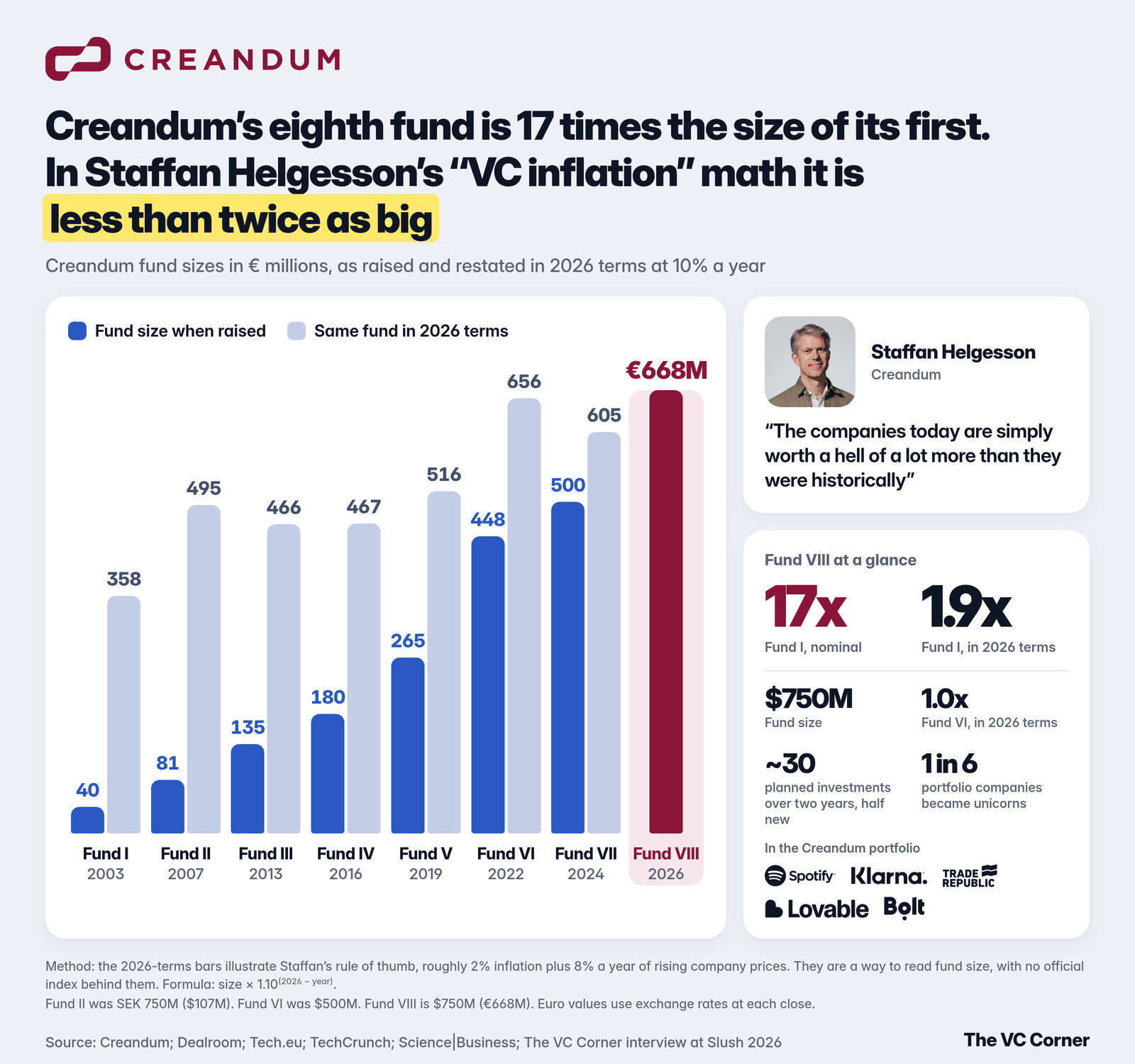
Creandum closed its eighth fund in November at $750M, the largest in the firm’s 23 years. Its founder, Staffan Helgesson, thinks most people read that number wrong, and his own math says the fund is about the same size as the one Creandum raised four years ago.
$750M (€668M) for Fund VIII, about a third more than Fund VII’s €500M in 2024
About 30 investments planned over the next two years, half of them new companies, from pre-seed to Series A
1 in 6 Creandum portfolio companies has passed a $1bn valuation
3x the size of its San Francisco team in two years
23 years running the same strategy: pre-seed and seed, and the most ambitious founders it can find
Who Staffan Helgesson is
Staffan founded Creandum in Stockholm in 2003 with a €40M first fund backed by two Swedish institutions, AP6 and Skandia. Before that he studied business in Lund, worked at IKEA, Procter & Gamble and McKinsey, including a stint as a consultant in San Francisco, and in 1999 started a venture firm focused on the mobile internet. Today he splits his time between San Francisco and Stockholm.
Creandum co-led Spotify’s Series A in 2008 after more than a year of negotiation, and its second fund, which also backed iZettle, returned about 13 times its money. Its exits include Spotify’s 2018 listing, PayPal’s $2.2bn purchase of iZettle, Etsy’s $1.6bn purchase of Depop and Uber’s acquisition of Cornershop, and it counts Klarna, Bolt, Trade Republic and Lovable among its unicorns.
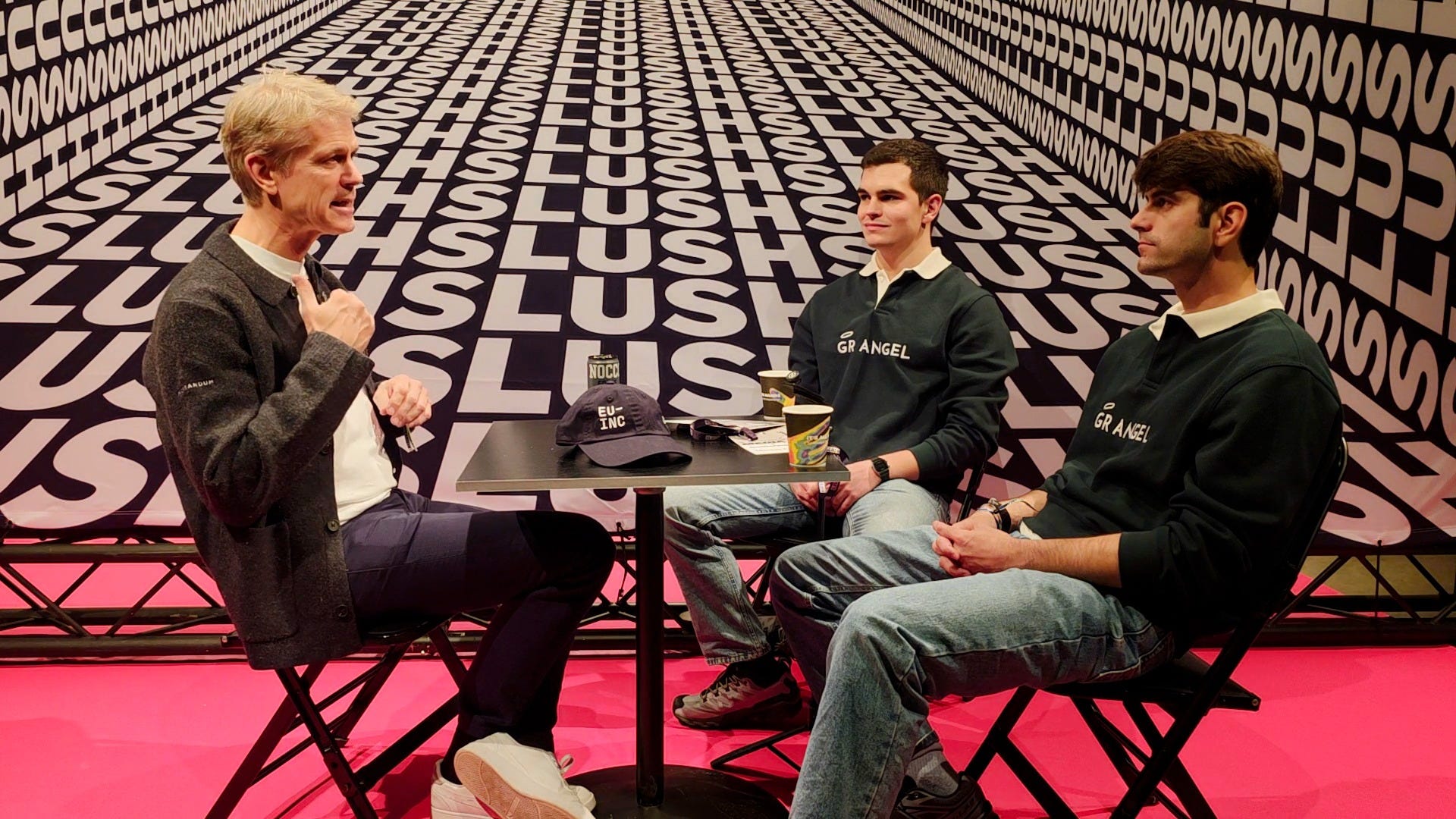
This was our second interview with Staffan. The first, How Creandum Built a $2B VC Fund Backing Spotify and Lovable, covered the firm’s origin story. This one, recorded at Slush in Helsinki a year later, covers what has changed since.
The 10 chapters in this interview
VC inflation and the size of Fund VIII. Why a $750M fund is smaller than it looks.
Creandum’s return to San Francisco. Why he now spends more than half his time there.
How Creandum picks AI categories. The Wayne Gretzky meetings.
The founder trait investors underrate. And the test he runs on every founder.
Exits as a receipt. What the founders of Spotify, Modal and Rillet have in common.
Reaching founders before they raise. Three to four days of travel every week.
The Stanford gym sign. The rule behind how Creandum competes for deals.
Building a VC partnership. The advice we asked for on our own behalf.
The scoreboard. The one metric Creandum tracks for the next 20 years.
Fixing startup rules in Europe. His bottom-up plan for 27 countries.
What Staffan told us, in 10 clips
1. VC inflation and the size of Fund VIII
“The companies today are simply worth a hell of a lot more than they were historically.”
Staffan thinks VCs and their LPs both miss what he calls VC inflation. Ordinary inflation adds a couple of percent a year, company prices keep climbing on top of it, and by his math the two together come to roughly 10% a year. At that rate a company priced at $100M today is worth about $259M in 10 years, so setting today’s fund sizes against today’s exit values mixes two different clocks.
He reads the old complaint that too much money is chasing too few deals the same way and calls it the wrong mindset, because with AI the opportunities are bigger than ever.
Creandum’s own funds, in Staffan’s math
We ran his 10% rule on Creandum’s history. Fund VIII is 17 times the size of the €40M first fund, and less than twice its size once both are stated in 2026 terms. It also comes out at about the same size as Fund VI, the $500M fund raised in 2022. By the founder’s own rule, the record fund is a steady one, which fits a firm that says it keeps its fund sizes disciplined.
Sizing a fund or pricing a round? Start here:
Return Analysis: How Top VCs Turn Forecasts Into Fund-Making Outcomes (+ Excel Template)
IRR vs Return Multiple Explained: The Venture Math Every Founder and VC Must Master
2. Creandum’s return to San Francisco
“AI is really transforming the world. Let’s be honest, the epicenter for that is San Francisco.”
Creandum opened in San Francisco in 2012, its first hub outside the Nordics, and gave up the office during COVID while keeping the people. It sounds crazy now, Staffan says, though at the time many people doubted the city’s future. A couple of years ago the firm decided it had to be there in full force, to hear what is coming, win the best deals and help its portfolio, and it has tripled its San Francisco team since. Staffan now spends slightly more than half his time in the city, on a commute of 24 hours door to door.
He sees the best companies priced about the same in Europe and the US, so he treats them as one global market. The average Silicon Valley company is stronger than the average European one, he adds, because the city is so expensive and competitive that only strong teams can afford to stay, which he calls a self-fulfilling prophecy. If you are weighing the move yourself, our guide to moving to San Francisco covers the practical side.
3. How Creandum picks AI categories
“Investors that are early into new emerging areas tend to do better than the ones that are not.”
Creandum runs strategy sessions it calls Wayne Gretzky meetings, after the hockey player who skated to where the puck was going. Staffan’s current example of an area about to break out is AI security, where Creandum has looked at a couple of companies and is still waiting for the right one.
Then he checks his own ego. An investor who thinks he is smarter than the market is in trouble, so the job is to listen to founders, who show you where the puck is heading. The best companies in a new area tend to start a bit too early, and his rule is to be a bit early yourself. That puts Creandum’s thesis on people more than on sectors, and the firm has backed companies across the AI stack, from applications down to the chips that run inference.
4. The founder trait investors underrate
“I think there’s 1 factor that’s a bit underestimated, and that is that you need to be obsessed.”
Companies need a lot of capital today, so founders have to be great at recruiting and at fundraising. On top of that Staffan wants energy that borders on obsession, a bit crazy even, because the work is brutal and drive is what carries founders through it. He points to how few European tech companies went public last year as a measure of how hard it is to make a company work, and adds that investing is hard too, as he expects us to find out.
His test is simple: would we want to work for this person? Ask him whether he prefers an A team with a B idea or a B team with an A idea, and he wants the A team with the A idea.
“We’re more flexible on what people plan to do than on how strong we believe the founders are.”
If you are raising, give your team more room in the deck than your roadmap. Our breakdown of what top-tier VCs look for in 2026 covers the rest of the checklist.
5. Exits as a receipt
“If you focus too much on the exit, I actually think you will miss some of the greatest opportunities.”
Ask the founders Creandum backs what drives them, and the answer is the product. Erik Bernhardsson at Modal, whom Staffan sat near at the speaker dinner the night before, wants to keep building for his users for another 10 to 20 years. Daniel Ek set out to make something better than piracy at Spotify, so music lovers could stop downloading files and renaming them. Rillet, the agentic ERP company Creandum backed, set out to make life easier for CFOs, and when Staffan interviewed CFOs at a Rillet user conference, they told him they love the product.
Creandum applies the same logic to itself: find the best founders, earn the right to back them, and the returns reach the LPs.
“It will come as a receipt on a job well done.”
6. Reaching founders before they raise
“Venture capital is about hustling. I call it street fighting.”
Staffan has no exact split between founders who arrive inbound and founders Creandum finds, though he says it is surprisingly often Creandum that reaches out first, which is how it got to Modal and to Black Forest Labs. The team tracks interesting people and moves when it learns something is about to happen. The investor team travels three to four days a week to meet founders where they work, and in Paris he and a colleague cross the city by bike between meetings.
Small, curated dinners do the rest. With the right people in the room, founders meet peers like themselves, an effect that fades at a big dinner. Founders are the customers, he says, and you go where the customers are.
Building your own founder or investor pipeline? Start here:
The Investor Outreach System: List, Prompts, Sequence, Replies
How to Build an Investor List With Claude That Investors Actually Answer
7. The Stanford gym sign
“The price always increases. What you did last year will not be enough this year.”
Staffan took the line from a sign at a gym at Stanford, where he went with his son a couple of years ago. Creandum applies it to winning deals: the playbook that won last year falls short the next, because venture gets more competitive every year as more capital and more investors arrive, in waves.
He pointed the rule at us too. To keep growing an audience, he said, you need better production this year than last, and the day that pressure fades is probably the day to stop.
“The day you start to think that you’re somebody, you’ve never been closer to being no one.”
8. Building a VC partnership
“Surprisingly often the better team beats the better roster.”
Guillermo and I are building GR Angel, so we asked Staffan how to pick a partner. His first answer: you have to like each other. Firms run on different models, from a fund to a firm to a franchise, and he treats each as a valid choice; Creandum chose a very team-oriented culture, and as a soccer fan he defends it with the line about rosters.
For a third partner, he suggests someone you like who complements you and knows the things you miss, and then accepting that you are different, which is when a team starts to work. Creandum grades its partners on investments, on building the firm and on developing people, and he wants each partner to be strong at two of the three, since excelling at all three is rare.
9. The scoreboard
“The metric for us is, are we in at least 1 of them?”
Each year, Staffan counts three or four companies in Europe that truly matter and maybe 10 to 15 in the US. Creandum’s test for the next 20 years is whether it holds a stake in at least one of them. He expects the firm to become more transatlantic, with a strong presence on both sides of the Atlantic, while Europe stays home.
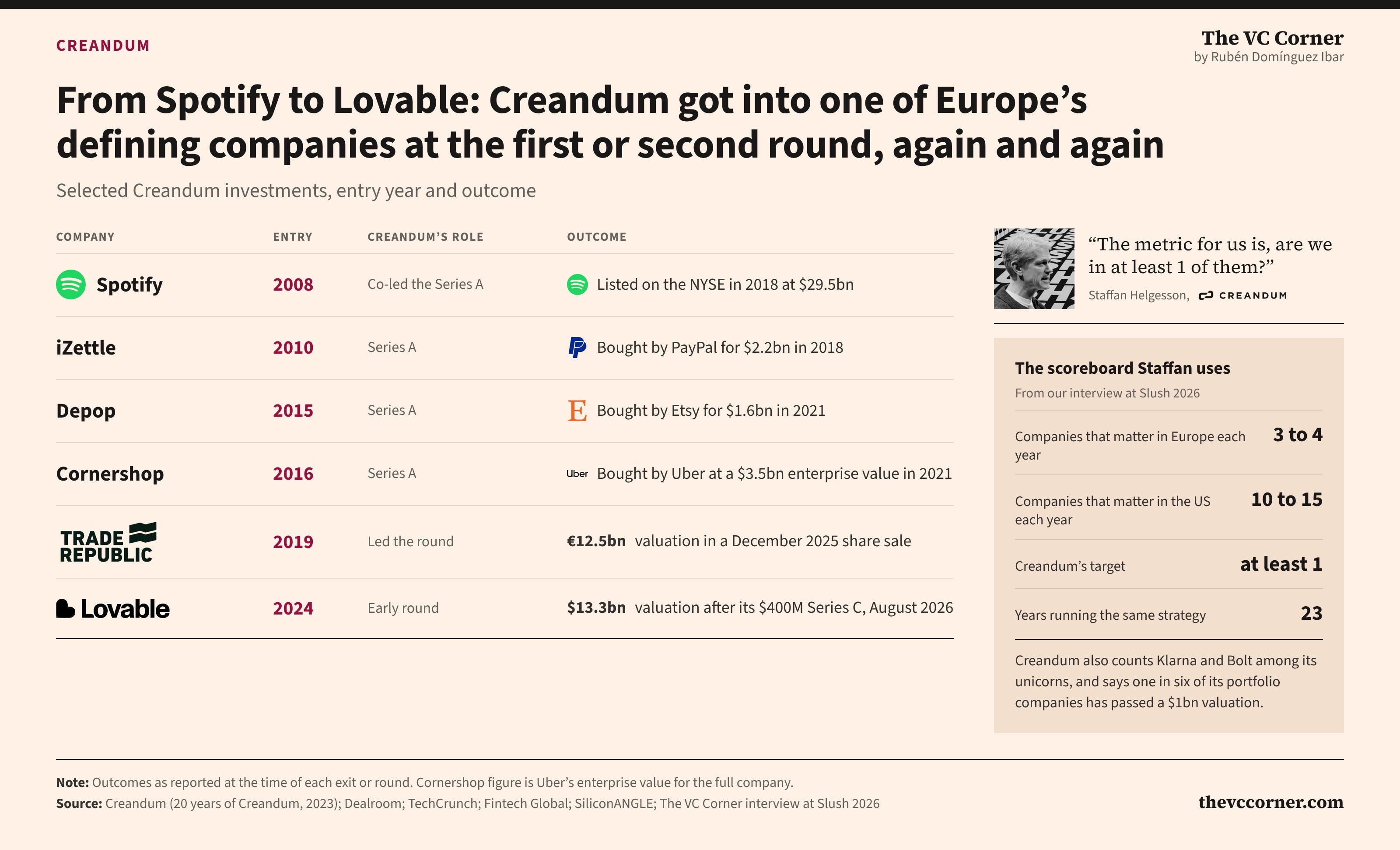
The track record shows why the metric works for Creandum. It entered Spotify, iZettle, Depop and Trade Republic at the first or second institutional round, years before any of them looked obvious, and Lovable, which it backed in 2024, reached a $13.3bn valuation in August.
10. Fixing startup rules in Europe
“Make sure that Spain is the role model, or let’s make sure that Sweden is the role model, so that we have what I call bottoms up change.”
Staffan calls Europe a fantastic base whose rules have to catch up. His list is short: make stock options easy to issue, make Europe one market, and drop the notary requirement, since DocuSign or HelloSign does the same job. Most people in the ecosystem know the list, he says, and the hard part is making it happen when 27 countries weigh in on every EU-level initiative.
So he challenges each government to become the role model. If one sizable country makes it work, the others will look at it and copy it. Estonia played a version of that role, he says, though at 1.3 million people it is too small to pull the rest of Europe along.
What I’m taking from Slush
Creandum has run one strategy for 23 years and still behaves like a challenger, with its founder spending more than half his time in San Francisco and a rule that last year’s playbook expires. Its eighth fund is its largest, and by Staffan’s own math it is about the same size as the one before it.
Founders: Creandum bets on the team before the idea. Give your team more room than your roadmap in the deck, and pick a product you would still want to build in 10 years.
Investors: Restate any fund size or valuation in the year the exits land, and write down the three or four companies that matter in your market each year.
Fund builders: Pick partners you like who cover your gaps, and grade each other on investing, building the firm and developing people.
Policymakers: One sizable country that fixes stock options and drops the notary could set the template for the other 26.
More from our Slush interviews: Plural’s Khaled Helioui on its €1bn fund and Balderton’s James Wise on the trait he screens founders for.
If this breakdown saved you time, send it to one founder or investor who needs it.