

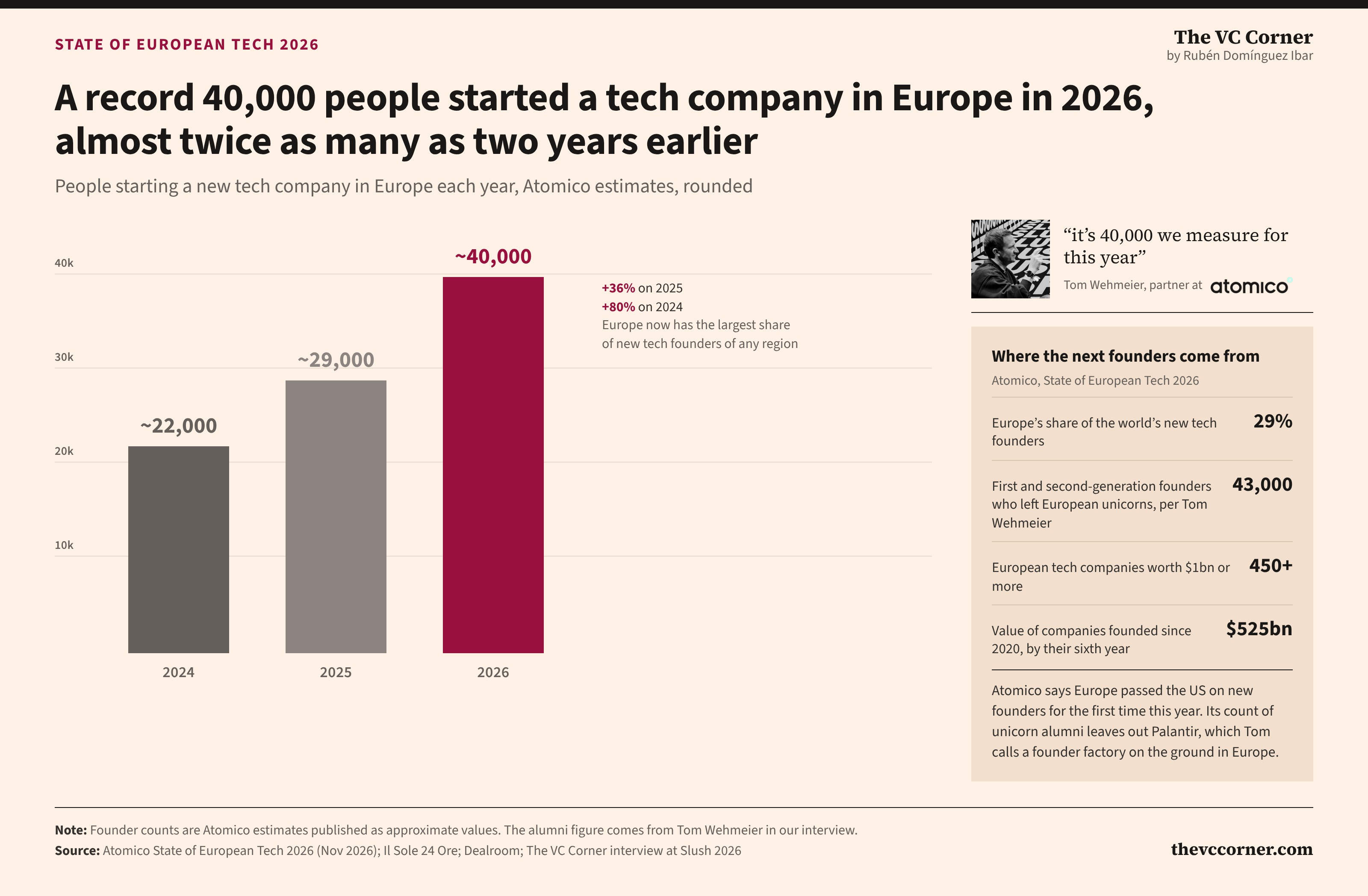
A record 40,000 people started a tech company in Europe this year, 80% more than two years ago, and for the first time Europe produced more new tech founders than the US. Its pension funds manage $13 trillion and put about 0.006% of it into European venture capital each year.
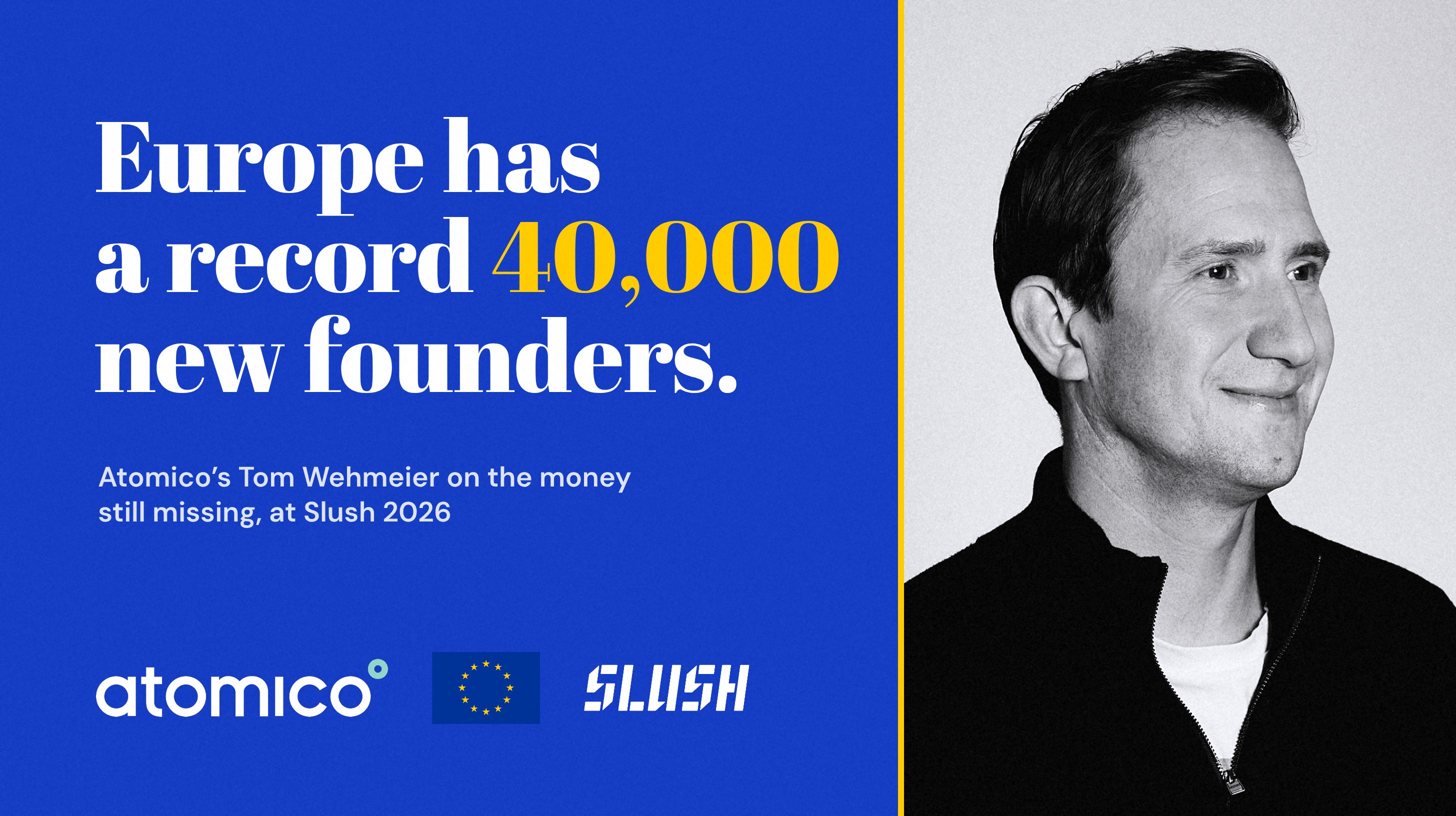
Those two numbers frame our interview with Tom Wehmeier, the Atomico partner who writes the State of European Tech report. The 2026 edition, its 12th, came out the week of Slush:
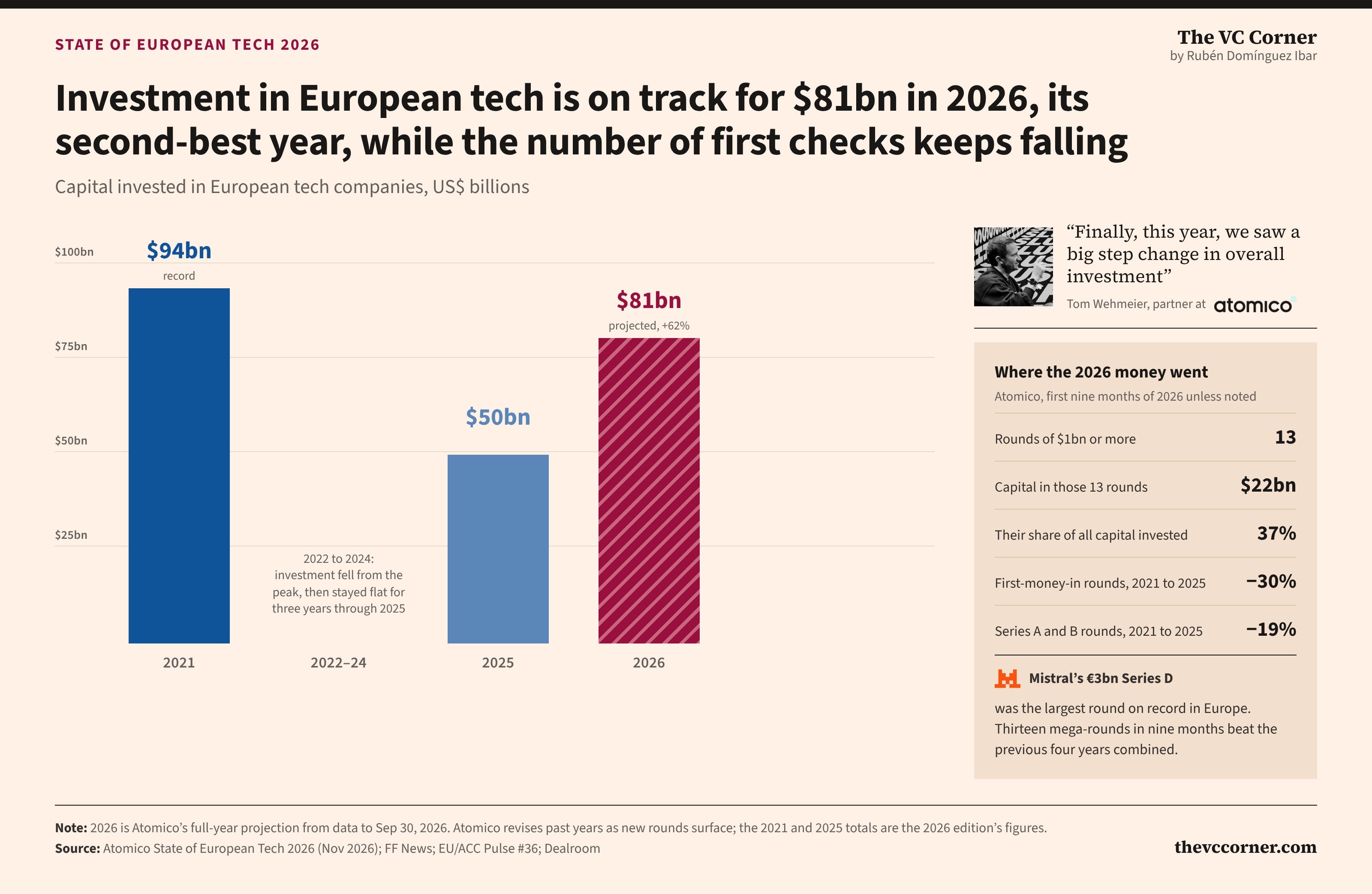
$81bn invested in European tech this year, up 62% and second only to the $94bn record of 2021
13 rounds of $1bn or more in nine months, more than in the previous four years combined
29% of the world’s new tech founders are European, the largest share of any region
Almost 30% fewer first-money-in rounds in 2025 than in 2021
$4.4 trillion in combined value across European tech, with more than 450 companies worth $1bn or more
Who Tom Wehmeier is
Tom is a partner and head of intelligence at Atomico, the London venture firm that Skype co-founder Niklas Zennström started in 2006. He spent most of a decade as a telecoms analyst during the move to smartphones, joined Atomico as a newcomer to venture and made partner in 2017. He started the State of European Tech 12 years ago, and its first edition closed with a line he says has held every year since: “this is the greatest time ever to be a European tech entrepreneur.”
Atomico has backed more than 155 companies across seven funds, from Supercell, which SoftBank valued at $3bn when it bought a majority stake in 2013, to the AI security company Lakera and PhysicsX, whose $135M Series B it led in 2025. In September 2024 it closed $1.24bn across an early-stage fund and a growth fund, the largest raise in its history.
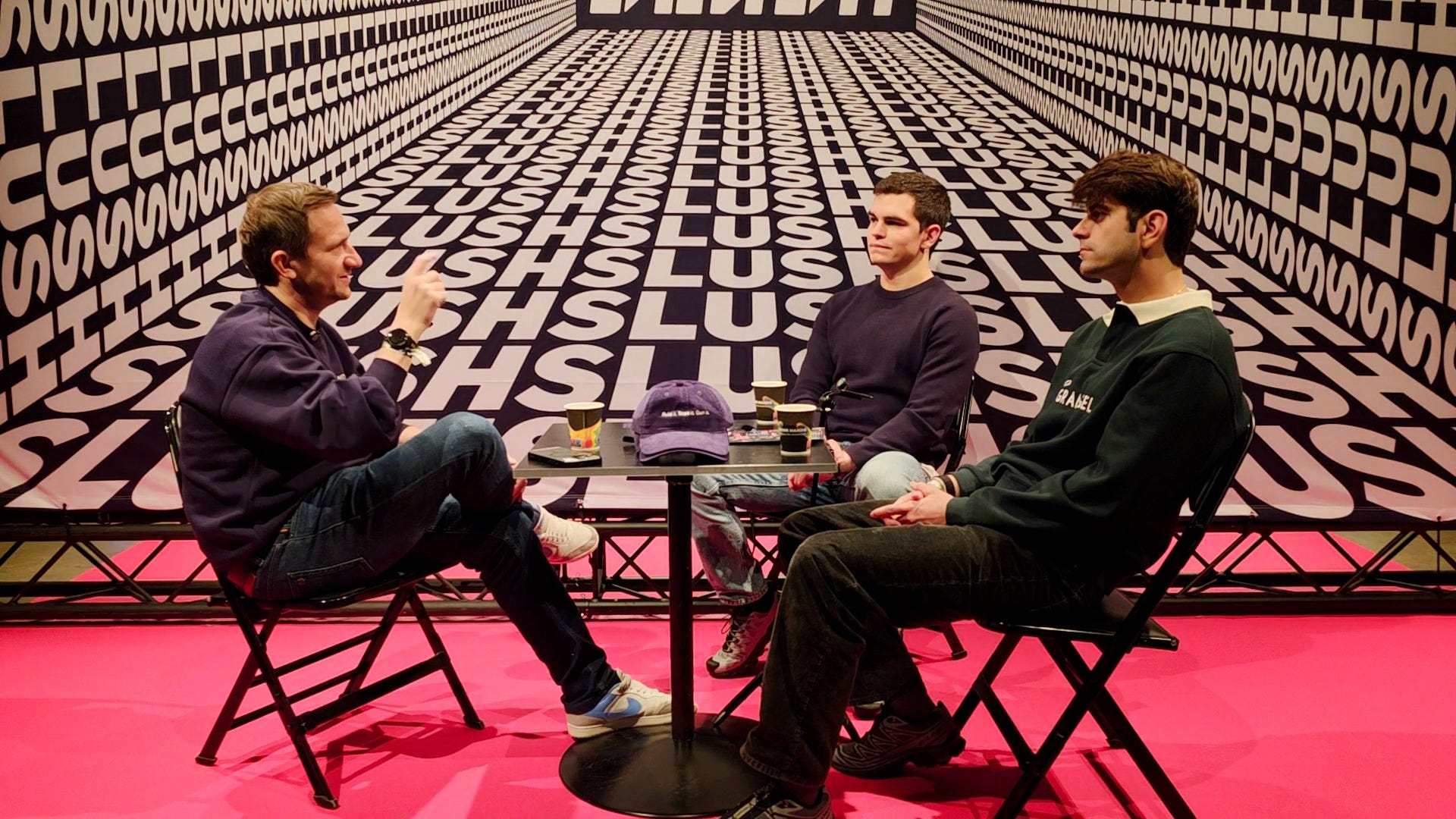
Guillermo Flor and I sat down with Tom at Slush in Helsinki for the full interview. We cut it into 10 clips, one per chapter, each with the data behind it and links to the VC Corner and AI Corner resources that go deeper.
The 10 chapters in this interview
How the story about Europe shapes where founders build. Who writes the narrative, and what the report is for.
Europe’s ecosystem after 12 years of the report. Why a unicorn stopped being the goal.
Border friction, Revolut and Spotify. How a hard home market trains companies to scale abroad.
The founder count and the alumni flywheel. Where 40,000 new founders came from in one year.
The 2026 investment rebound. What the $81bn includes, and where most of it went.
Mega-rounds and the early-stage gap. Why outliers rarely look like outliers on day one.
Pension funds and insurers. The $13 trillion pool that sends 0.006% to venture.
European VC returns and the expertise gap. Why the blocker for pension money is hiring.
EU Inc and Delaware. The policy fix Tom ranks first right now.
Risk culture. Where the mindset has to live, from classrooms to trustee boards.
What Tom told us, in 10 clips
1. How the story about Europe shapes where founders build
“people will decide where to build their company based on that perception, right?”
Tom’s starting point is perception. A founder picks a city based on what they believe about it, and much of the global tech narrative comes from the US, often as memes that people take at face value. That story lowers ambition in Europe, and a founder who keeps hearing that the action is in San Francisco has every reason to build there.
The report is Atomico’s counterweight. Tens of thousands of people download it each year, though the result Tom cares about, belief in the ecosystem, resists measurement. VCs thank him because they pitch Europe to their own investors and the report hands them the evidence, while policymakers use it as a united industry voice in what he calls a slow grind toward better rules.
Evidence has opened the policy rooms, and bringing the public along is the part still to do. If you are weighing where to build, our piece on startup location strategy covers what still matters about the choice.
2. Europe’s ecosystem after 12 years of the report
“we’ve built a world-class ecosystem here. I think we sometimes don’t act like we’ve done that.”
Compared with 12 years ago, when the report began, or 20 years ago, when Tom started in tech, the change is total, and on many measures Europe now sits right next to the top ecosystem in the world. The bar moved with it. A unicorn used to be the ambition, and today it barely registers as a successful outcome.
Tom finds it wild that Europe can now talk with confidence about a path to a $1 trillion company, a race we covered in Europe’s race to $1 trillion. The report’s slogan for this year runs on three verbs: build it, scale it, own it.
3. Border friction, Revolut and Spotify
“I think that that will end up being an advantage, right? That builds resilience into the foundations of that organization that helps them to scale in other parts of the world, too.”
Revolut is Tom’s first example of what Europe produces: relentless founders, the talent that joins them and the belief to keep building. It sits outside Atomico’s portfolio, and Tom says everyone wishes it sat in theirs.
Spotify’s Daniel Ek fits the same pattern. Founders like him have told the report team that building from Europe meant crossing borders and rules from the first year, and that the friction built resilience and a moat, because those companies learned how to do it. The move to the US was hard for them too.
The friction runs both ways. American companies find Europe hard to enter, and how hard depends on the category, since pure software travels far more easily than a health tech company arriving with its own regulators to satisfy.
4. The founder count and the alumni flywheel
“it’s 40,000 we measure for this year. And that is up 80% from 2 years ago.”
The count also rose 36% on 2025, and Europe now holds 29% of the world’s new tech founders, ahead of the US for the first time. Tom credits AI for lowering the cost of building, along with an ecosystem that finally makes founding look like a good career.
The second engine is alumni. Tom says the report counts 43,000 first and second-generation founders who spun out of European unicorns, and that tally leaves out Palantir, which he calls a founder factory on the ground in Europe. Those founders reach the starting line with more ambition, more know-how and denser networks, which he calls a warm start. Our list of Europe’s exited founders shows who many of them are.
“success breeds success. One generation feeds the next.”
5. The 2026 investment rebound
“Finally, this year, we saw a big step change in overall investment. So, it’s up to 81 billion we’re projecting for the year. That’s 62% increase on last year.”
Investment fell from the 2021 peak and the first half of 2022, then sat flat for three years. Atomico now projects $81bn for 2026, up from $50bn in 2025 and second only to the $94bn of 2021, extrapolated from data through September 30. Tom felt the change all year, down to $1bn seed rounds that sounded impossible a few years ago, and he wants the industry to say out loud that many of the fastest-growing companies of all time are European.
Inside the $81bn
I would read the headline number with care. Atomico counts 13 rounds of $1bn or more in the first nine months of the year, worth $22bn and 37% of all capital invested. Take those out and the rest of the market raised about $37bn in nine months, close to the roughly $37bn that 2025’s $50bn implies for the same stretch. That is my arithmetic on Atomico’s figures, and it puts most of the rebound inside a handful of giant rounds.
6. Mega-rounds and the early-stage gap
“it is more often than not actually the case that the eventual outliers were pre-consensus at the start.”
Tom says the top 5 rounds this year add up to about 25% of all capital invested, more than double the level Europe has seen before. Lower down, first-money-in rounds fell almost 30% between 2021 and 2025, and Series A and B rounds fell 19%. He welcomes the growth-stage firepower, since Europe needs to put capital behind its winners, and the worry sits at inception: a few founding teams read as outliers on day one and raise giant seed rounds, while most outliers look ordinary when they start.
His fix is more early-stage capital, from new emerging managers and early-stage funds that can grow with round sizes, so Europe backs ideas while they are still ideas. Leading a $50M or $100M seed round takes serious firepower, and the investors with the most conviction and speed at that size often sit outside Europe.
Guillermo and I write first checks through GR Angel, and the 30% drop in first-money-in rounds is the number from this report I will watch most closely next year.
Raising or writing first checks in Europe? Start here:
7. Pension funds and insurers
“we’re still at a rounding error point at this point in time.”
Here are the numbers behind that line. European pension funds manage about $13 trillion and commit around $780M a year to European VC funds, roughly 0.006% of their assets and under a quarter of the US rate, while insurers put in 0.005%. Europe’s endowments and foundations trail their US peers in size and number, so the big money sits with pension funds and insurers.
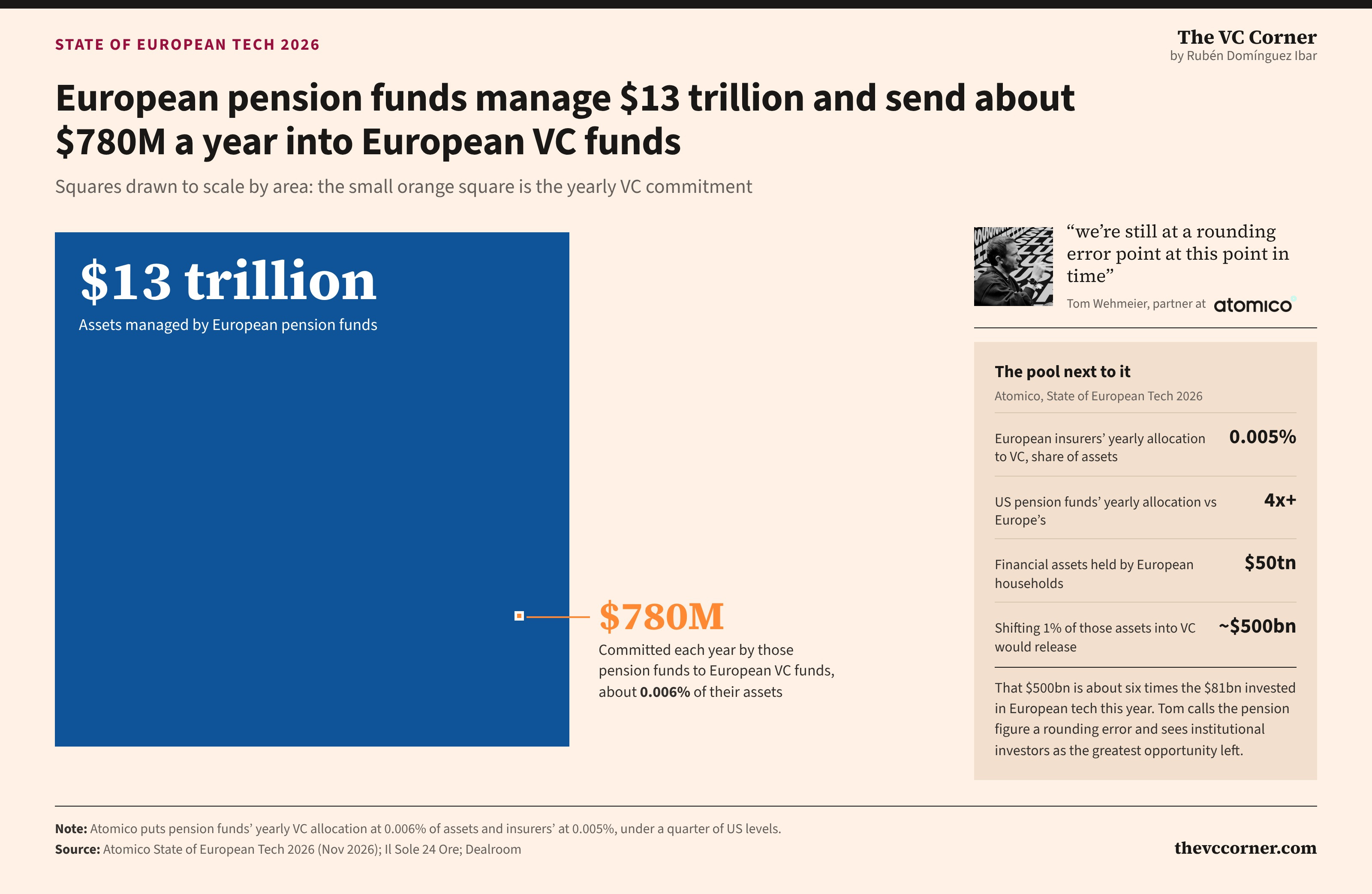
The report maps the programs built to close the gap, and Tom’s definition of impact is strict: scaled, durable commitments made year after year and manager after manager, of which there is very little so far. A pension fund new to venture starts with a capability gap, since venture is hard to read for a team trained in fixed income, private equity, property or infrastructure.
The pension gap is the largest pool of unused capital in European tech. Atomico estimates that moving 1% of European households’ $50 trillion in financial assets into venture would add about $500bn, six times everything invested in European tech this year.
Raising from institutions? Start here:
8. European VC returns and the expertise gap
“there aren’t yet enough people that have the expertise and the experience to be able to develop a program.”
European VC has held up against the US over long horizons at the median, in the top quartile and in the top 5%, and in any vintage year the best-performing funds can be European. That removes part of the case for staying out. The gap sits in the middle, because a pension fund needs people who understand venture before it can move from zero to scaled commitments.
Governments filled the early gap. The European Investment Fund is the largest single investor in European VC funds, and national players like the British Business Bank, Bpifrance and KfW do the same job country by country. Tom sees that public money as catalytic: it built a venture market from a tiny base 20 years ago, and its share shrinks as private institutions arrive.
The signal he watches is hiring. Pension funds and insurers are bringing in specialists, some poached from the US, to build their venture programs.
9. EU Inc and Delaware
“where we need to end up is a version of EU Inc. that founders will actually use and that becomes a credible alternative to Delaware.”
EU Inc, the proposed pan-European company form, is still in negotiation, and the version on the table is already diluted. Tom ranks it first among Europe’s policy fixes right now, ahead of reforms that might matter more on paper, as long as Europe gets it over the line.
The reason is trust. Policymakers have said for years that startups and scale-ups matter for growth and for a resilient Europe, and EU Inc tests whether they meant it. A result that fixes the problems everyone agreed on in the diagnosis would start a snowball and a shared sense that founders and policymakers are on the same side, while a weak one would cost that trust. National negotiations are under way, and Tom praised the EU Inc team for its persistence.
Deciding where to incorporate? Start here:
10. Risk culture
“we should treat risk culture like its core infrastructure.”
Tom puts risk culture on the same shelf as energy and financial markets: a shared habit of going after ambitious things when the path is hard and failure is likely. He wants it in graduates leaving university and on the trustee boards of pension funds, and he wants corporates to give startups a chance to prove themselves even when the product carries risk.
That ties back to the last verb of the slogan. Owning it means Europe tells its technology story with confidence, through the people who build here every day.
“the biggest risk is not taking any risk.”
What I’m taking from Slush
Europe has fixed its founder problem faster than its capital problem. The founders, the alumni networks and the mega-rounds are here, while first checks are getting scarcer and the largest pool of patient money in Europe still treats venture as a rounding error.
Founders: You start with more ambition, know-how and networks than any earlier generation. Ask one alumni founder from a European unicorn for an intro this week.
Investors: Mega-rounds took 37% of the capital while first-money-in rounds fell almost 30% in four years. Take one first meeting this month with a team raising its first round.
Operators: European unicorns have produced 43,000 alumni founders, and Palantir’s spinouts come on top. Before your next role, ask who from that company went on to start something.
Pension trustees and corporates: Both sit on Tom’s risk-culture list. Ask how venture fits your allocation, or run one pilot with a European startup this quarter.
More from our Slush interviews: Balderton’s James Wise on the trait he screens founders for and Plural’s Khaled Helioui on its €1bn fund.
If this breakdown saved you time, send it to one founder or investor who needs it.